<?xml version="1.0" encoding="UTF-8"?>
<feed xmlns="http://www.w3.org/2005/Atom">
  <title type="text">The Mason Experience: Past and Present</title>
  <updated>2026-04-17T19:45:23+00:00</updated>
  <generator uri="http://framework.zend.com" version="1.12.20">Zend_Feed_Writer</generator>
  <link rel="alternate" type="text/html" href="https://pastandpresent.curatescape6.reclaim.hosting/"/>
  <link rel="self" type="application/atom+xml" href="https://pastandpresent.curatescape6.reclaim.hosting/items/browse?output=rss2"/>
  <id>https://pastandpresent.curatescape6.reclaim.hosting/</id>
  <author>
    <name>The Mason Experience: Past and Present</name>
    <uri>https://pastandpresent.curatescape6.reclaim.hosting</uri>
  </author>
  <link rel="hub" href="https://pubsubhubbub.appspot.com/"/>
  <entry>
    <title type="html"><![CDATA[Fenwick Library: Serving George Mason University Since 1967]]></title>
    <summary type="html"><![CDATA[<p><strong><em>Completed in October 1967 Fenwick Library has occupied the same spot for over 56 years. While it has undergone many changes over the years, its mission to facilitate access to scholarship and information and teach the effective and critical use of information remains the same. </em></strong></p><img src="https://pastandpresent.curatescape6.reclaim.hosting/files/fullsize/041022fd2a911150eb2fd26684361054.jpg" alt="Fenwick Library, view from the southeast" /><br/><p>George Mason University Libraries began operation in September 1957 at Bailey's Crossroads Campus, occupying three of the four rooms on the upper level of the building. As the number of library resources increased, librarians, who moonlighted at Bailey's while employed at other local libraries, stored newly acquired resources in closets and bookcases sitting in hallways.  </p><p>When the college moved into the new campus at Fairfax in 1964, a permanent college librarian was hired by the University. Patrick Joseph Larkin, a recent graduate of the Master of Library Science at nearby Catholic University was chosen to head up the new Library. Initially, the Library was located on the 2nd Floor of the new Fairfax Campus' East Building.  During this time planning for Mason’s permanent stand-alone library at Fairfax was gearing up with Larkin and officials from George Mason College and the University of Virginia actively participating in the design and functionality groundwork. </p><p>Mason's permanent Library was designed for a “commuter college” with specific needs: a large commuting student body, an evolving program of studies, and a rapid growth rate.  Mason had less than 1,000 students during the late-1960s, but more than twice that many after only five years. In 1966 a report of the Northern Virginia Regional Planning and Economic Development Council estimated that by 1985, 15,000 high school graduates would be knocking on Mason’s doors. </p><p>The architectural firm Vosbeck-Vosbeck & Associates of Alexandria designed a two-story white concrete-columned structure with alternating brick panels. The building contained 31,500 square feet, housed up to 60,000 book volumes, and seated almost 500 readers.  Construction began in July 1966 at a cost of $1.2 million (a little more than $10 million in 2023).          </p><p>The library took about fifteen months to complete. By the third week in October 1967, it was ready for use. On move-in day library staff, along with dozens of volunteers from the student body, carted some twenty thousand volumes from the East Building to the new library to be shelved.  The building was formally dedicated on December 15, 1967, in an hour-long ceremony which was concluded with an announcement that it would be named Fenwick Library, after State Senator Charles Rogers Fenwick, a longtime political ally of George Mason College. </p><p>By 1974 enrollment at George Mason, now a university, had increased by more than 500% since 1967. Library space expanded to keep up with the demands of a growing university.  This came in the form of two adjoining towers, one completed in 1974, and the other in 1983. The towers now known as Wings B and C increased the library’s storage space by twelve times. During the late 1980s there were plans to increase library space once again, but these plans were scrapped to design and build the facility now known as the Johnson Center.  Beginning in the 1980s, the stage for Mason Day band performances was placed on the plaza in front of the Fenwick Library entrance and for nearly twenty years, the sounds of live music would permeate the library on that day. </p><p>Beginning in September 2012 Fenwick Library underwent a four-year transformation to bring it up to par with other major university libraries in the commonwealth. This addition, which opened in 2016, wrapped the existing Wing B and C towers and doubled the library’s space, enabling the university to meet growing needs for a variety of study and research spaces.</p><p><em><strong><a href="https://pastandpresent.curatescape6.reclaim.hosting/items/show/5">For more (including 7 images) view the original article</a></strong></em></p>]]></summary>
    <published>2022-10-20T20:48:43+00:00</published>
    <updated>2026-04-17T19:45:23+00:00</updated>
    <link rel="alternate" type="text/html" href="https://pastandpresent.curatescape6.reclaim.hosting/items/show/5"/>
    <id>https://pastandpresent.curatescape6.reclaim.hosting/items/show/5</id>
    <author>
      <name>George Mason University Past and Present Team</name>
    </author>
  </entry>
  <entry>
    <title type="html"><![CDATA[The Bailey&#039;s Crossroads Campus: George Mason University&#039;s Humble Beginnings]]></title>
    <summary type="html"><![CDATA[<p><strong><em>After being approved for operation by the Virginia General Legislature in 1956, the institution that became George Mason University began in an old elementary school building at the intersection of Columbia and Leesburg Pikes in the Bailey's Crossroads section of eastern Fairfax County in the fall of 1957. </em></strong></p><img src="https://pastandpresent.curatescape6.reclaim.hosting/files/fullsize/6efec2b482850e1aecfa7e8223b2ddb6.jpg" alt="George Mason College, Bailey&#039;s Crossroads Campus" /><br/><p>The former Bailey’s Elementary School located at 5836 Columbia Pike was a small well-used eight-room red-brick schoolhouse built in 1922. “Old Bailey’s” was abandoned in 1954 for a new one nearby.  The University of Virginia leased the building from Fairfax County Public Schools for $600.00 per year, moved into the building in the summer of 1957, and began classes that September with seventeen students. John Norville Gibson Finley, formerly an English professor from the campus at Charlottesville was named the college's director. </p><p>The lower level had four classrooms (two science labs and two lecture rooms). Up the creaky staircase from the mail entrance were three rooms that comprised the library and one classroom. </p><p>Because all spaces in the building were in use at all times, there was no place for students to socialize before and after class. To help remedy this, the Bailey’s Crossroads Volunteer Fire Department next door kindly allowed students at the college to use the station’s upstairs break room and bingo hall as a lounge. </p><p>Space for other collegiate activities was always at a premium. There was no room that could house more than 30 people comfortably. As a result, functions such as assemblies, meetings, dances, and Final Day Exercises (since there were no terminal degree programs at the branch “Final Day Exercises” were the equivalent of commencement) were held at locations nearby, such as the Bailey’s Crossroads Fire Department, the Alexandria Episcopal Seminary, and local hotels and churches. Athletic events, which were never more than a pick-up or faculty vs. student game, took place either on the dirt field adjacent to the building which doubled as overflow parking or on the fields of local schools, such as Glen Forest Elementary School, which was located one-half mile to the northwest.</p><p>Bailey’s served as the primary location for the University College (which would later be renamed George Mason College in January 1960) from September 1957 until August 1964. Though conditions were challenging for the early pioneers at Bailey’s Crossroads, the students, staff, and the local population became fond of their school, and some were even sad to have to leave. </p><p>The staying power of Bailey’s (or BXU as some Mason students affectionately called it) is a testament to the commitment of the people of Northern Virginia toward higher education. Individuals from all backgrounds and parts of the area labored to make certain that Bailey’s would make a go of it until more permanent quarters were available. This was finally realized on August 27, 1964, when the last of the moving vans left Bailey’s with equipment and furniture bound for the brand-new permanent campus just south of Fairfax.</p><p><em><strong><a href="https://pastandpresent.curatescape6.reclaim.hosting/items/show/3">For more (including 8 images) view the original article</a></strong></em></p>]]></summary>
    <published>2022-10-12T19:42:52+00:00</published>
    <updated>2026-04-17T19:45:23+00:00</updated>
    <link rel="alternate" type="text/html" href="https://pastandpresent.curatescape6.reclaim.hosting/items/show/3"/>
    <id>https://pastandpresent.curatescape6.reclaim.hosting/items/show/3</id>
    <author>
      <name>George Mason University Past and Present Team</name>
    </author>
  </entry>
  <entry>
    <title type="html"><![CDATA[The Bailey&#039;s Crossroads Volunteer Fire Department Hall and Other Hangouts: Student Life at the Bailey&#039;s Crossroads Campus]]></title>
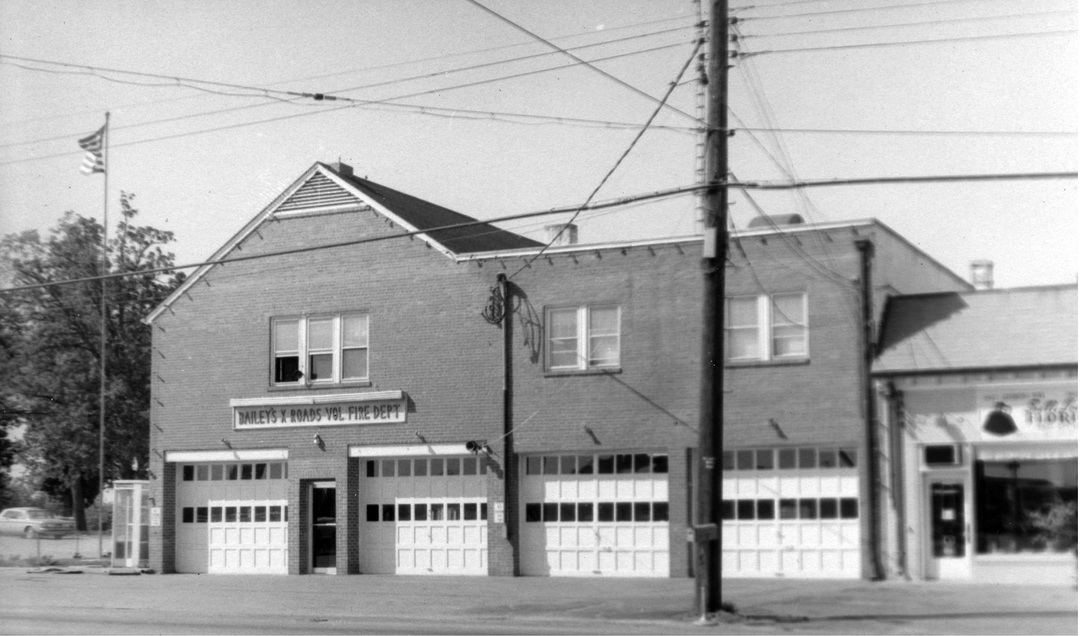
    <summary type="html"><![CDATA[<p><strong><em>Because the Bailey's Crossroads school building was so small, students used the neighboring firehouse meeting hall as their student lounge from 1959 to 1964. They also enjoyed patronizing neighborhood businesses. Campus life at Bailey's centered around these locations.</em></strong></p><img src="https://pastandpresent.curatescape6.reclaim.hosting/files/fullsize/ffeeda3b70558ea508b42ff334d73814.jpg" alt="The Bailey&#039;s Crossroads Volunteer Fire Department Station" /><br/><p>Since George Mason College had no dorms, students spent their free time between morning and afternoon classes on or near campus. The combination of a small school building and constant togetherness fostered strong bonds between students and faculty, creating a casual learning environment with great camaraderie. Oral history interviews with former students Richard Sparks, Ann Walker Sparks, James Heath, Nancy Buddeke Heath, Helen Momsen, and Douglas Nelms describe the closeness and the spirit of fun that characterized student life at Bailey's. Additionally, Sparks and Nelms pursued photography as a hobby and captured students' experiences at George Mason College in Bailey’s Crossroads in the 1960s. </p><p>The neighboring Bailey’s Crossroads Volunteer Fire Department graciously offered to let the students use their second-floor meeting hall as a student lounge. It became a significant part of student life at Bailey’s Crossroads. They spent time between classes and ate their lunches there. Momsen and Nelms remembered students playing card games, including Bridge, Hearts, and Spades in the student lounge. Fire sirens occasionally disrupted the students’ leisure time since the fire station was in active use. </p><p>The student lounge featured soda and candy vending machines, which the student body owned and moved from the schoolhouse to the fire hall. The fire department hosted bingo games in their meeting hall on the weekends. Heath recalled refilling the soda machines because they were empty by the middle of each bingo game. As a result, the student body had a steady supply of money for the treasury. They eventually sold the vending machines to the fire department.</p><p>When not in the student lounge, students spent time in the small campus library, played sports on the lawn and patronized nearby businesses. Nelms enjoyed Gifford’s Ice Cream and ate lunch from Steak ‘N a Sack, a restaurant owned and operated by a Palestinian immigrant family. Sparks bought lunch from the nearby Krispy Kreme because it was inexpensive, and he did not have to cross the highway. Walker Sparks ate lunch from Hot Shoppes, just across the highway, and Burger Chef, a McDonald’s competitor. They also enjoyed movies at the Flying Saucer Drive Inn on Leesburg Pike. Sparks highlighted some of these places a map he created in the early 2000s.</p><p>The student government met in the fire department hall, where they held debates and elections. In the spring of 1963, Momsen, then a first-year student, ran for student body president as the first female candidate, losing by fewer than ten votes. As a consolation prize, an administrator handed Momsen a stack of mimeographed pages. These were copies of the then-current student "newspaper", <em>Perspective</em>. She was offered the job of editor of the student newspaper. Momsen used her connections to establish a high-quality newspaper for George Mason College, which she named <em>The Gunston Ledger</em>. <em>The Gunston Ledger</em> became the chronicle of student life and created a legacy of Mason student media that continues today.</p><p>Although the students knew that the Bailey’s Crossroads campus was temporary, they were fond of their school. Nelms gleefully recalled students playing pranks on each other and their professors. Sparks admitted that when he first arrived, he did not take his studies seriously and frequently skipped classes. However, despite students’ laid-back attitudes toward learning, they admired and respected the faculty. For example, Sparks and Heath recognized the positive impact that Dr. Fanny-Fern Davis had on their academic and career development. Buddeke Heath concurred that the teaching was “first-class.” Although Walker Sparks and Sparks continued their education at other prestigious schools, they felt most attached to Mason.</p><p>The students’ pride in the Bailey’s Crossroads campus is evident in their determination to establish a campus culture and lasting traditions and their bittersweet feelings toward moving to the Fairfax campus. An excerpt from Kathy Howell’s “Winding up the Semester that Was” column in <em>The Gunston Ledger</em>, Volume 1, Number 4.5, details students’ affinity for their campus and its culture.</p><p><em><strong><a href="https://pastandpresent.curatescape6.reclaim.hosting/items/show/2">For more (including 10 images) view the original article</a></strong></em></p>]]></summary>
    <published>2022-10-06T16:06:07+00:00</published>
    <updated>2026-04-17T19:45:23+00:00</updated>
    <link rel="alternate" type="text/html" href="https://pastandpresent.curatescape6.reclaim.hosting/items/show/2"/>
    <id>https://pastandpresent.curatescape6.reclaim.hosting/items/show/2</id>
    <author>
      <name>George Mason University Past and Present Team</name>
    </author>
  </entry>
</feed>